
The New Scientist has reported that three Asian hornet queens (Vespa velutina) were captured in Essex in March this year, more than a month earlier than migrants from mainland Europe usually arrive here.
Genetic analysis has found them to be the offspring of a nest that was destroyed in the same area in November of last year. This is the first time that Asian hornets have been known to overwinter here in the UK and the experts are beginning to suggest that it might be an indication that they are here for good.


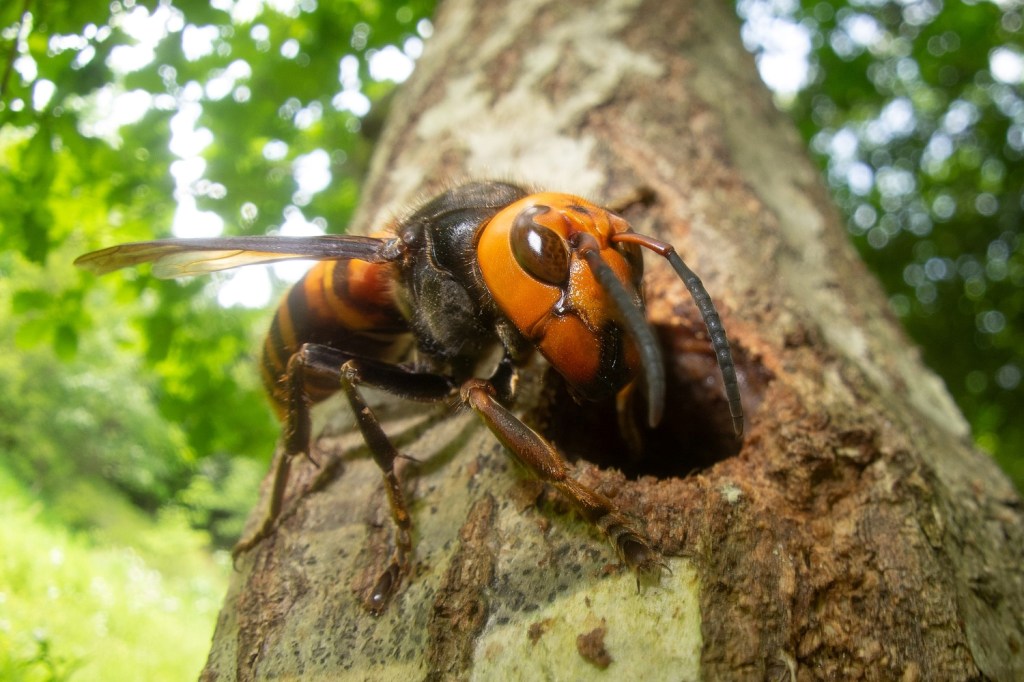
Over the last decade, Europe and the USA have been subject to the attentions of two invasive species of hornet from Asia, and the scary parts of the media haven’t really bothered to distinguish between them: they are the Asian hornet (Vespa velutina) and the giant Asian hornet (Vespa mandarinia), the latter unhelpfully nicknamed murder hornet by the media.
Our native European hornet (Vespa crabro) is a mild mannered creature, big and noisy enough to make you jump but its intentions are good. Every year there is at least one European hornet’s nest somewhere in one of the reserve’s hollow trees.

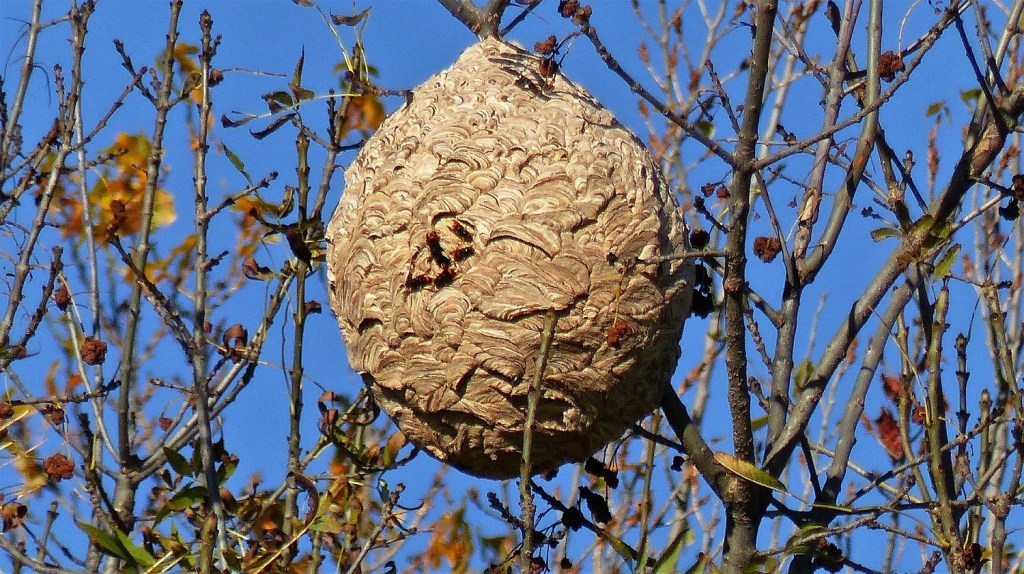
The European hornet’s nest was photographed in the reserve by Clive Knight in 2022
The species that has just been found to have overwintered in Essex is the Asian hornet (Vespa velutina) . It is smaller than the European hornet and much darker in colour but it is not thought to be any more aggressive than our native species. It is being treated as a potential problem because it hunts honey bees and the apiculture industry is worth something in excess of £150 billion a year. Money talks – and sometimes it spreads rumours of personal dangers that don’t really exist.
On the other hand, giant Asian hornets (Vespa mandarinia), no matter what the Mail online says, have never been identified in Europe; they are an American problem. Even if individual queens did turned up here, hibernating in some imported hothouse plant, they are tropical creatures that would not survive our winters. And while they are known to defend their nests vigorously, they are not thought to be any more aggressive towards humans than either the European or Asian hornet. They are not a danger to us here in the UK; we have other things to worry about.
Scare stories attract numbers and numbers feed the algorithms. Perhaps our only defence is to get out our bikes, cycle to the library, and look it up in a book.




 Southwick Country Park Nature Reserve
There was a hornet flying over my garden pond and dipping its tail into the water. Why is it doing that?
I expect this was not a hornet but a female dragonfly – probably a broad bodied chaser – and she was laying her eggs, one at a time, in the water. Broad bodied chaser females DO look like hornets: here is a picture taken in the reserve by our in-house wildlife photographer Simon Knight: