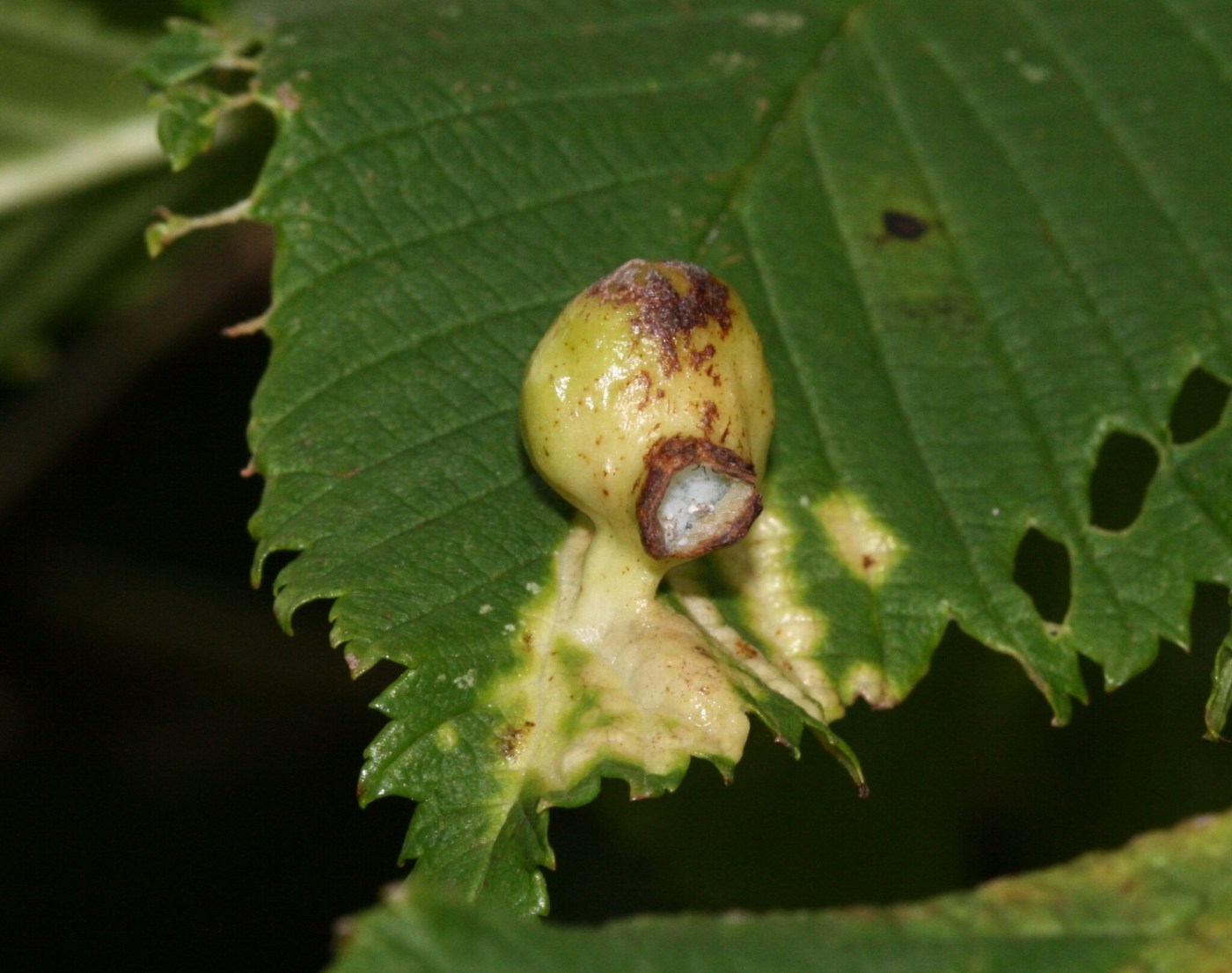
Let’s end National Insect Week with a real doozy: this is a fig gall on an elm leaf in the hedge between Sleepers and Cornfield. It is caused by Tetraneura ulmi, an elm-grass root aphid with a very complicated and quite astonishing life cycle.
It begins quite simply with a mated female aphid, laying a single egg on an elm leaf. A pouched gall on a stem forms around the egg, and inside the gall, the egg hatches into a pregnant female called a fundatrix. The fundatrix matures inside the growing gall for about three weeks and then gives birth to thirty or forty already-pregnant nymphs: clones of herself.
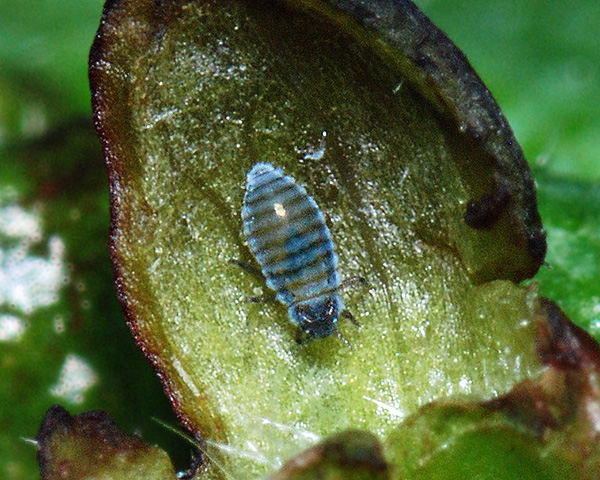
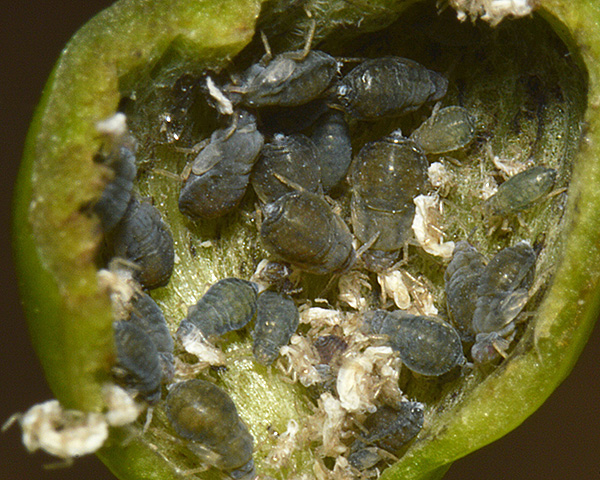
1 The fundatrix; 2 her clones growing inside the fig gall;
The clones feed and grow inside the gall and develop into winged adults (remember: all females, all pregnant) which leave the gall in June and July. Each winged adult female abandons the tree and flies off to colonise the roots of one of several species of grass. There she gives birth to many orange-coloured, wingless nymphs, all genetic copies of herself, despite their different colour.
The grasses are the secondary hosts (the elm tree is the primary host) and these secondary-host colonies are sometimes farmed by ants, on grass roots that are growing inside the ants’ nest. The aphids are sap suckers; they are feeding on the sugars produced by the photosynthesising, above-ground part of their host plant, and they excrete a sweet honeydew that the ants collect and use to feed their own colony. In exchange, the ants protect the aphids and take care of the root system they are feeding on.
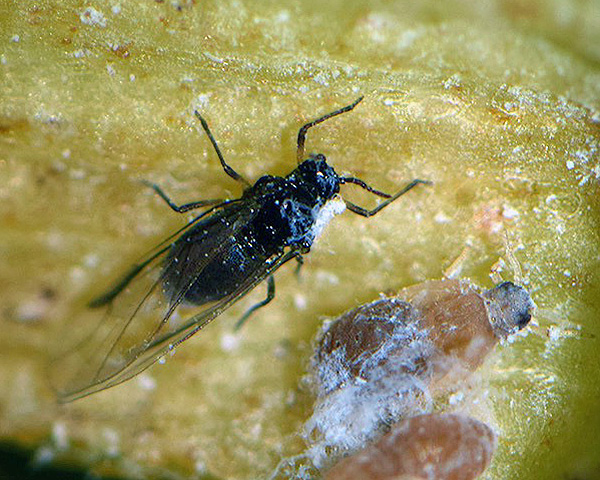
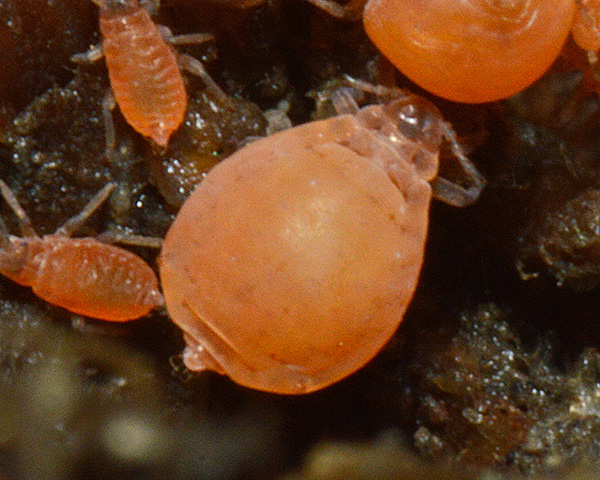
3 the winged adult form leaves the gall and…
4 colonises the roots of a grass with orange wingless nymphs.
In September some of the orange, cloned nymphs develop into winged forms which make a return journey to the elm trees, where they produce yet more wingless clones that feed on the bark, leaves and stems, and then overwinter in the shelter offered by the tree.
In the spring the nymphs mature into winged males and females. These sexual forms leave the tree on which they have developed to search for mates from different colonies. Each mated female will then lay her eggs on elm leaves and the process begins again. The capacity to reproduce several generations asexually, by parthenogenesis, is one of the reasons that aphids are such a widespread and successful family of insects.
Our reserve is full of these extraordinary stories of intertwined insect life cycles. Too often we stroll through oblivious to the intricacies going on around us.
Header image: fig gall by S. Rae (CC BY 2.0) wikimedia.com


 Southwick Country Park Nature Reserve
Fascinating! Such a complicated but successful lifecycle. Barbara Johnson
We forget that when ants farm aphids, they are accessing the products of photosynthesis. The plants make sugars, the aphids suck the sap from the plants and excrete honeydew. the ants collect the honeydew and feed it to their grubs. Energy from the sun straight down to the larvae in an ants’ nest.