
Another post about a plant that has many common names: ragwort.
Some of those names, like stinking willie and marefart, are not just common, they are downright vulgar. Both refer to the plant’s unpleasant smell. Another set of names, staggerwort, stammerwort and sleepy-dose, are about to its toxicity: if eaten, it can have severe neurological effects. Then there is felon weed, swine grass and our personal favourites: scrog and weeby.
To go with its unsavoury nicknames, Ragwort has an unsavoury reputation: an aggressive weed, common to wasteland, poisonous to livestock, subject to legislative control since 1959, almost impossible to get rid of. But there is another side to this story.


Reliable sources say that there are 30 species of invertebrates that are wholly dependent on ragwort. The cinnabar moth,Tyria jacobaeae, (above) is the best known and most recognisable of these. It lays its eggs exclusively on ragwort and its caterpillars eat the leaves down to their stalks before moving onto the next plant. They absorb toxic alkaloids from their diet, a fact they advertise with black and yellow stripes to warn predators.
At least ten of these 30 species are scarce or rare; here are two of them: Longitarsus dorsalis and Icterica westermanni


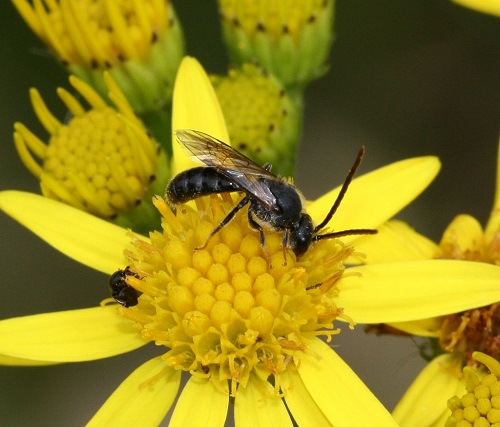
Altogether, nearly 200 invertebrate species have been found feeding on ragwort in the UK. The nectar-rich, pollen-heavy flowers are an increasingly important food source for generalist feeders in the late summer when other sources are waning. They are the flowers most frequently visited by our dwindling butterfly populations.
Let’s look after our ragwort.




 Southwick Country Park Nature Reserve