
Where have all the wasps gone?
At the end of the summer or at the beginning of autumn, a wasp nest reaches a maximum size and its queen produces her last batch of eggs. She lays these, individually, in cells specially prepared for them by her workers. These are the thousand or so eggs that will develop into one half of the colony’s reproductive generation: the virgin queens. Elsewhere in the nest, unfertilised eggs, produced either by the queen or by her workers, will become the fertile male drones. Thereafter, the queen lays no more eggs and the workers make no more cells.
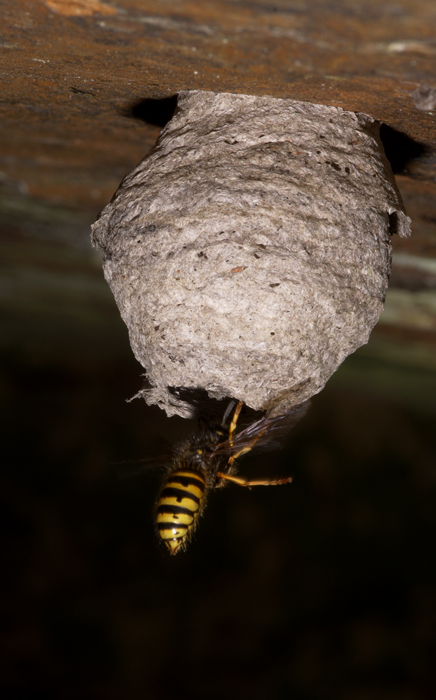
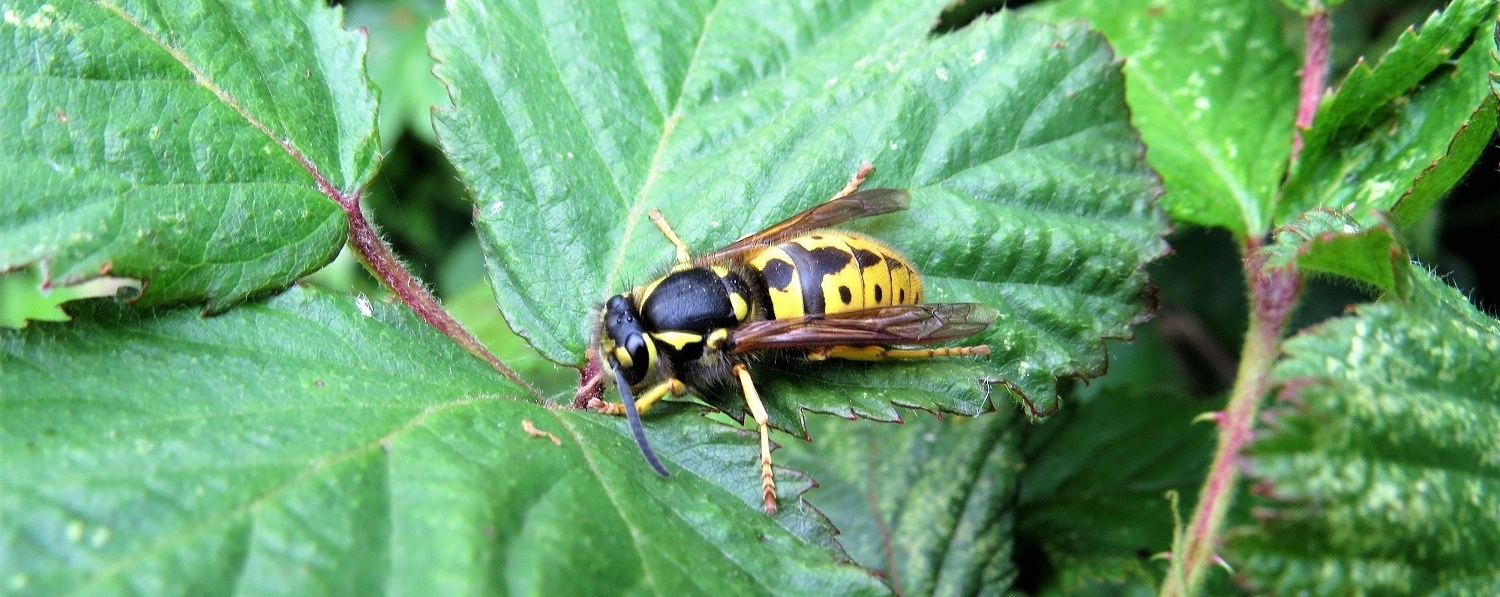
Until she has six or seven workers, a queen wasps feeds the colony.
When a prosperous colony is growing during the summer, an egg will become an adult wasp in just four weeks. But it can take up to six weeks if there there are queen larvae in the nest. Foraging workers will always give the queen larvae priority. They are fed first and the larvae destined to be workers get the leftovers; this is what slows their development. The adult worker, when it emerges from its pupa, might live another three weeks.
So, after the queen produces the reproductive generation and either becomes inactive or dies, the nest has a maximum life expectancy of about nine weeks: the six weeks gestation and three-weeks-long life of the final clutch of worker-eggs. Let’s guess that the last of the worker adults will live to the end of October. But in the meantime, hundreds of wasps reach the end of their short lives every day (maximum three weeks, remember?) and are not replaced. The nest’s population is slowly declining.


As the nest grows, the queen loses the capacity to fly and is cared for and fed by her workers
The newly hatched queens stay while there are enough workers to feed them and fatten them up for their forthcoming overwintering, but the drones are driven out to fend for themselves. When there are not enough foraging workers in the nest, the new queens leave to mate with the waiting drones. The social structure of a wasp nest is controlled by the queens’ pheromones and without them, that structure begins to break down.
When the new queens are gone and the worker population has reached a critical low, there is anarchy. For a start, everybody is hungry: worker wasps have few enzymes in their guts and can’t digest much of the food they collect, but the larvae that they feed excrete a predigested, sweetened honeydew which is a major part of the worker’s diet. As the number of larvae in the nest falls and there isn’t enough honeydew to go around, starving adult wasps frantically chase sugar outside the nest but take to cannibalism inside, where they eat the remaining larvae. At this stage, wasps have been observed pulling the nest apart and carrying pieces away.


As the number of larvae in the nest decreases, the workers search for sugar.
The newly mated queens, as the weather cools, will find dry shelter and enter diapause. But without workers to warm the nest, its structural integrity already damaged, the first frost will prove fatal to the remainder of the colony.
In warmer climates, a wasp nest can survive the winter. One or more of the new queens will replace the old queen and resume egg production, and then there will be new workers to keep the nests’s temperature steady and to feed the larvae. The second season nest will be bigger: one such recorded in New Zealand contained an estimated four million cells. Something for us to look forward to as our climate warms and our winter frosts become less severe.

References:
Manaaki Whenua Landcare Research: Life cycle of a wasp » Manaaki Whenua (landcareresearch.co.nz)
Natural History Museum: https://www.nhm.ac.uk/discover/what-do-wasps-do.html




 Southwick Country Park Nature Reserve