
Bees buzz in two different ways.
Firstly, their rapid wingbeats create vibrations in the air which people hear as a buzz. In general, the larger the bee, the slower it beats its wings and the lower the pitch of the buzz. This is a phenomenon of wingbeats and not specifically of bees; the wingbeats of flies, beetles, dragonflies and wasps also buzz. The wingbeats of tiny bees like the small scissor bee are so fast that the buzz they make is outside the range of human hearing.


Honey bee and bumblebee working in the reserve.
The second way bees buzz is by vibrating the muscles of their wings and thorax; these vibrations are very rapid and produce a loud, high pitched, shrill sound. Honey bees only do this to generate heat and to communicate in the hive but some species of bumblebees do it in order to shake pollen from the anthers of the flowers they visit. This sort of pollen-releasing buzz is confined to female bees: males do not collect pollen.


Woody nightshade and a small scissor bee
Some plants seem to have adapted to this buzz-pollination (also known as sonication), producing their pollen in tubular anthers with narrow openings. When the bee vibrates the flower at a specific frequency, the pollen falls out of the tubular anther straight onto the bee.
Tomatoes and green peppers do this and consequently bumblebees pollinate these crops much more efficiently than honeybees do. In the reserve, woody nightshade is buzz -pollinated by bumblebees.

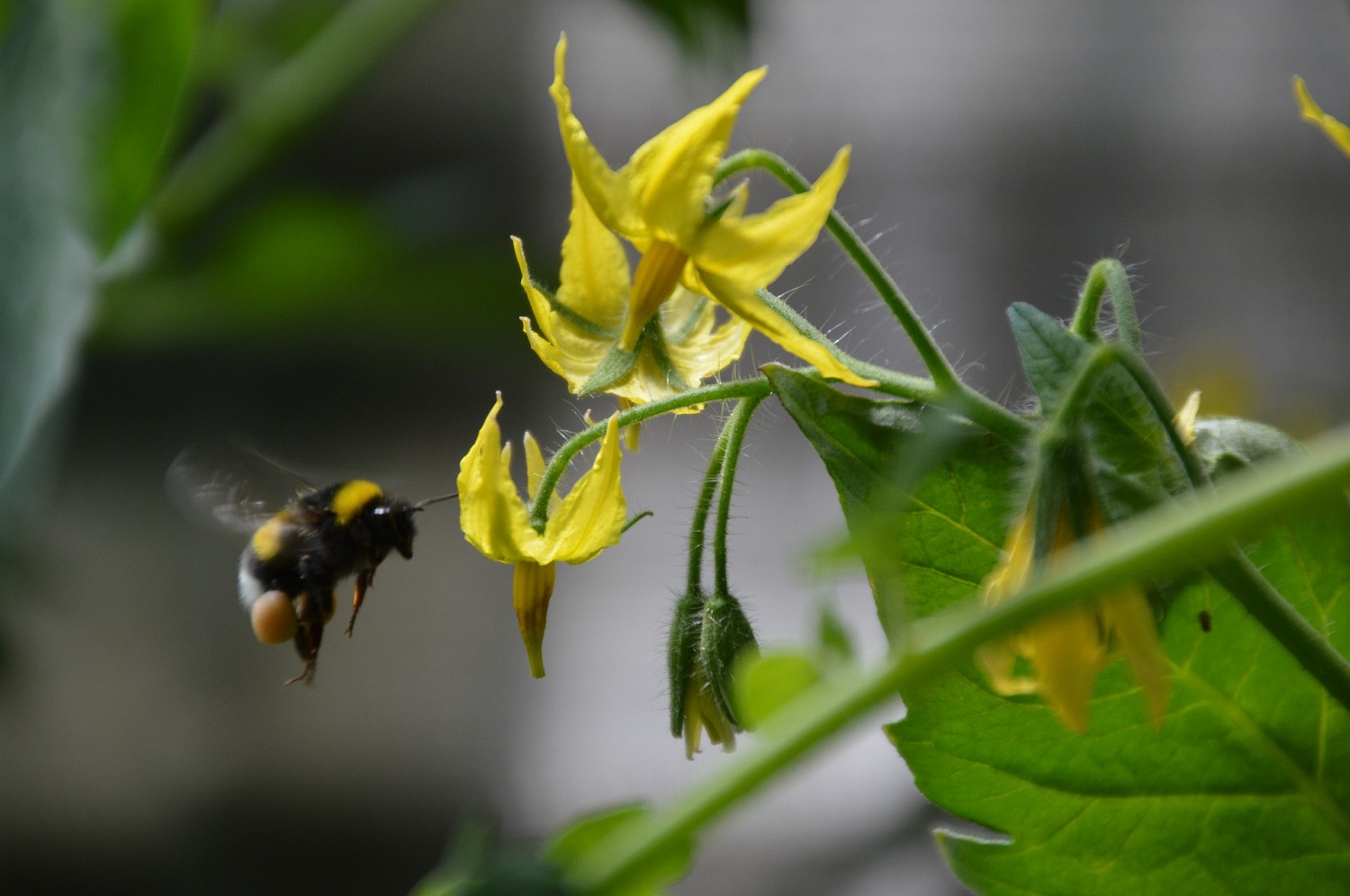
Tomato flowers with tubular anthers and a visiting buff tailed bumblebee,
The pollen, shaken loose by the buzzing, is attracted by the electrostatic charge on the bee’s fur. The bee scrapes some of the pollen off its fur into (depending on its species) sacs, brushes or baskets on its hind legs or under its abdomen, to be taken back to its hive or nest, but what is left on the bee’s body may fertilise the next flower the bee visits.
Header picture: buff tailed bumblebee by Vera Buhl (CC BY-SA 3.0) wikimedia.org




 Southwick Country Park Nature Reserve
Like the bumble bee sings to the flower to make it give up its pollen.
Not only that, Harrison, but a song sung in a particular key. It makes me wonder if the bumblebee has to buzz at different frequencies for different species of flower. I’ll see if I can find out.